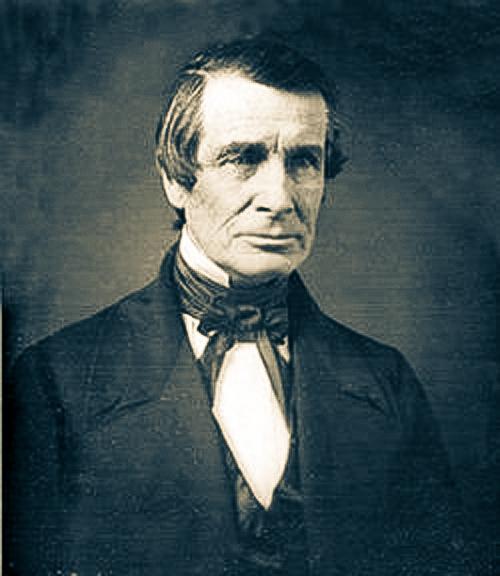
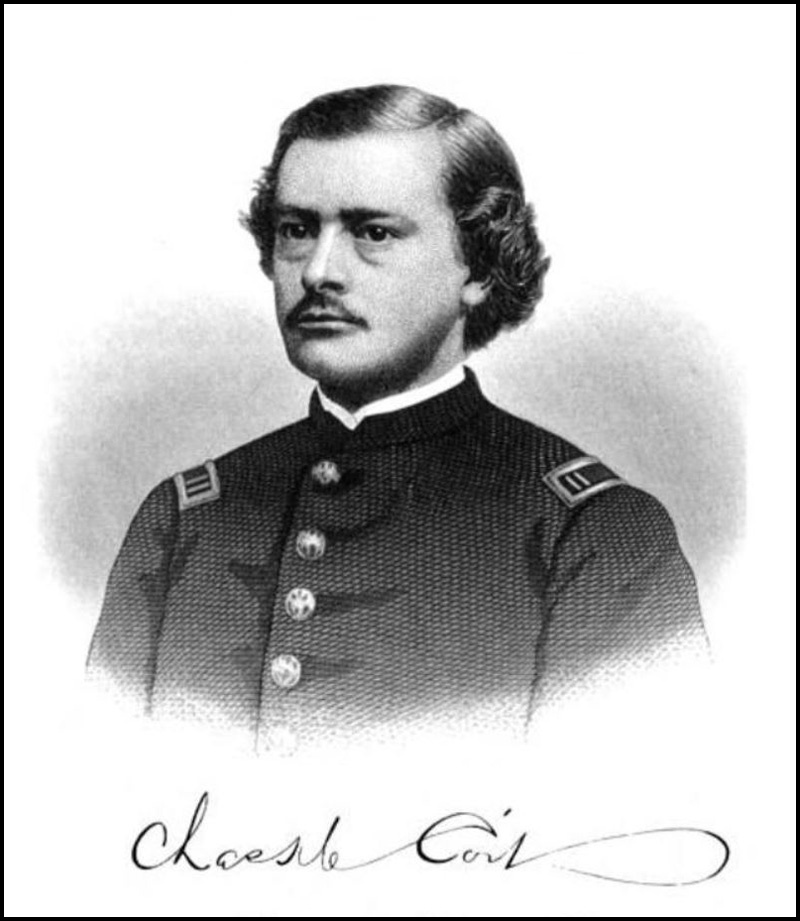
1780-1867 Dr. Erastus Osgood

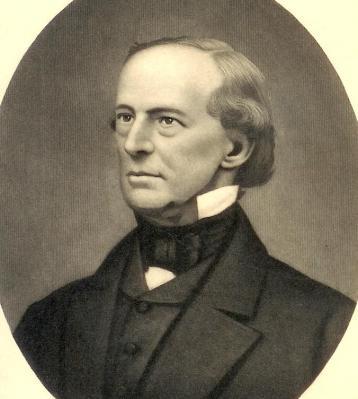
Erastus Osgood was born in Pomfret, Connecticut, in 1780.  He became a physician in Lebanon, CT, and the patriarch of the Osgood family. Lebanon and Norwich were home to, and the scene of, the activities of Dr. Erastus Osgood’s descendants throughout the 1800s. The Doctor himself, a leading citizen and skillful physician of Lebanon, reared five sons who all settled in Norwich and became prosperous merchants and men of prominence.

Erastus Osgood joined the Medical Society in 1826 and remained a member until 1867. He was one of the most honored citizens of Lebanon, where he practiced for forty-six years and earned more than a local reputation. He also took an active interest in the public affairs of his community, and his fellow citizens showed the esteem in which they held him by electing him to many positions of trust. He was long a most influential member of the board of school visitors, represented his town in the State Legislature and his district in the Senate, and filled various local offices to everyone’s satisfaction.

*Place your cursor over the photo to magnify

Dr. Osgood married Martha Morgan, daughter of Captain Elisha and Olive Coit Morgan. They reared a family of seven children, all born in Lebanon.

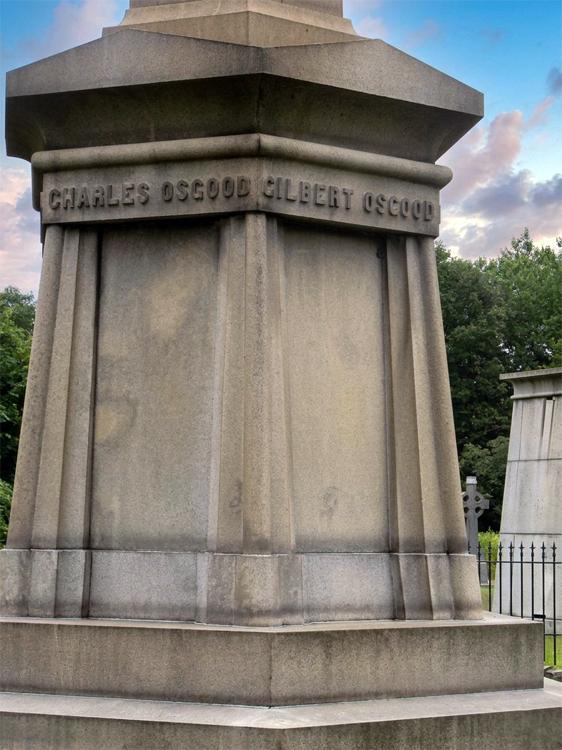
  • Charles, born February 13, 1808 (died 1881), was a druggist and served as Norwich’s mayor from 1876-1877
  • Olive, born March 4, 1810 (died 1906)
  • Erastus S., born January 2, 1813 (died 1854)
  • William C., born January 8, 1816 (died 1909), was a director of Dime Savings Bank
  • Samuel C., born November 2, 1819 (died 1820)
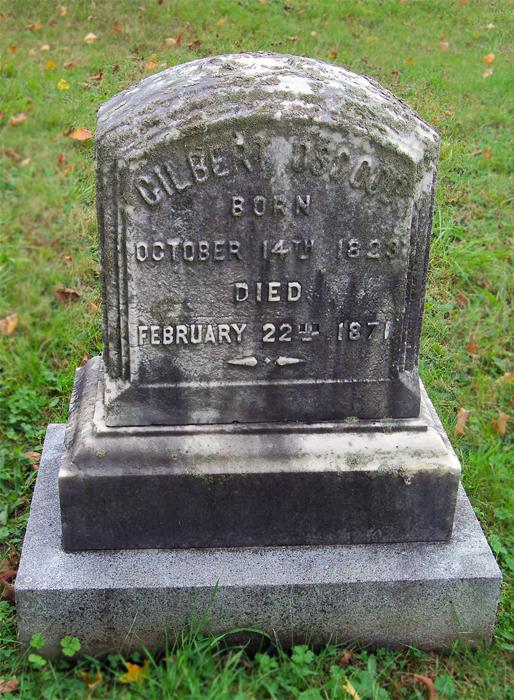
  • Gilbert, born October 14, 1823 (died 1871)
  • Edward, born February 5, 1826 (died 1871)

All of the five sons who reached maturity became merchants in Norwich. Several are buried in Yantic Cemetery, and their biographies appear below.

He lived to the advanced age of nearly eighty-eight years. Erastus Osgood died on December 29, 1867, and his wife, who was born on April 21, 1787, passed away nine years later, on February 26, 1876.

References

1808-1881 Dr. Charles Osgood

Charles Osgood was born in Lebanon, CT, in February 1808. After graduating from Plainfield Academy, he continued his medical studies, likely influenced by his father, Dr. Erastus Osgood, a successful physician who practiced for nearly half a century. Charles graduated with a medical degree from Yale and began practicing in Providence, RI. However, he soon relocated to Monroe, Michigan, where he joined an extensive and thriving medical practice. In 1840, Charles returned to Norwich and, the following year, established his drug business, which soon made his name known in the East’s business circles.

He set up his first laboratory and drug store on Shetucket Street in the same building later used by the Henry Bill Publishing Company. Later, a much larger building was located at 45-47 Commerce Street, which sold drugs, patent medicines, white lead, painters’ supplies, kerosene oil, chimneys and burners, Masury’s railroad colors, and Osgood’s steamboat oil (a water-white illuminating oil with a 150-degree test). His business grew and prospered, and soon Charles Osgood was ranked among Connecticut’s most notable millionaires.

In addition to the pharmaceutical business, Osgood was connected with many prominent manufacturing and corporate institutions, including the Boston Rubber Shoe Co. in Malden, MA; the Brown Cotton-Gin Co. at New London; the Norwich City Gas Co. He was the founder of the Shetucket Bank and president until 1853, and Vice President of the Norwich Savings Society. He was director of the New London Fire Insurance Co. and of the Norwich Water Power Co. He was also the president of the New London Junction Railroad.

With a mind toward civil responsibility, Charles Osgood was a founder and incorporator of Norwich Free Academy. He served as mayor of Norwich but resigned halfway through his term because of failing health.

He died in March 1881, leaving his wife Sarah, their two sons, Charles Henry and Frederic, and a daughter (wife of A.C.Tyler of New London).

References

1816-1891 Sarah Smith Larned Osgood

*Place your cursor over the photo to magnify

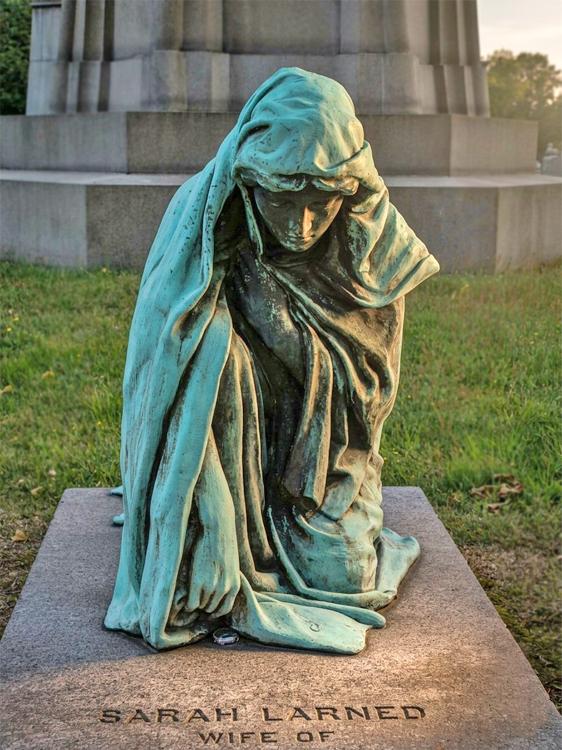
 Sarah  Smith Larned Osgood was the wife of Charles Osgood, who served as mayor of Norwich from 1876 to 1877. Their daughter, Cornelia Osgood, married Augustus Cleveland Tyler, son of noted Civil War Brigadier General Daniel P. Tyler.  Daniel Tyler’s granddaughter, Edith Carow, became First Lady of the United States after marrying Theodore Roosevelt.

Sarah’s bronze statue, nicknamed the “Blue Lady,” is arguably the most beautiful monument in the Yantic Cemetery.  Made of bronze and wearing a blue gown, she sat in the same location for more than 119 years, bowing on top of the placard bearing Mrs. Osgood’s name, looking lifelike amidst the city of graves in the Yantic Cemetery. One would swear that her eyes were real and not metal, especially when bathed in the glow of car headlights. One tale says the lady holds a rose, a Bible, or a rosary, depending on the day of your visit. Some even speculated that the statue was the work of famed sculptor Augustus Saint-Gaudens, but that proved untrue.

The Blue Lady was stolen in late 2009 or early 2010. The theft, reported on February 19, 2010, appears to have occurred a week or two earlier. Thieves cut her statue into three pieces and sold them as scrap. Thinking something was suspicious, the scrap yard put aside the two pieces they bought till the theft was reported. The third piece, the statue’s head, was later found perched atop a wall in a vacant lot in nearby Willimantic. Authorities later caught and arrested the perpetrators.

In the fall of 2011, the City of Norwich decided to use money from its cemetery fund for the approximately $25,000.00 ($38,000 in 2026 $) restoration of the statue, with Sculpture and Decorative Arts Conservation Services of Somerville, Massachusetts, doing the work. The Blue Lady was reset in place in the fall of 2011.
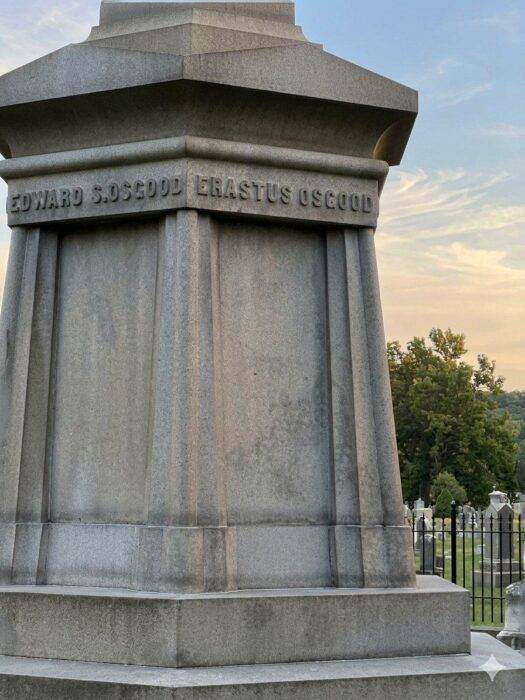
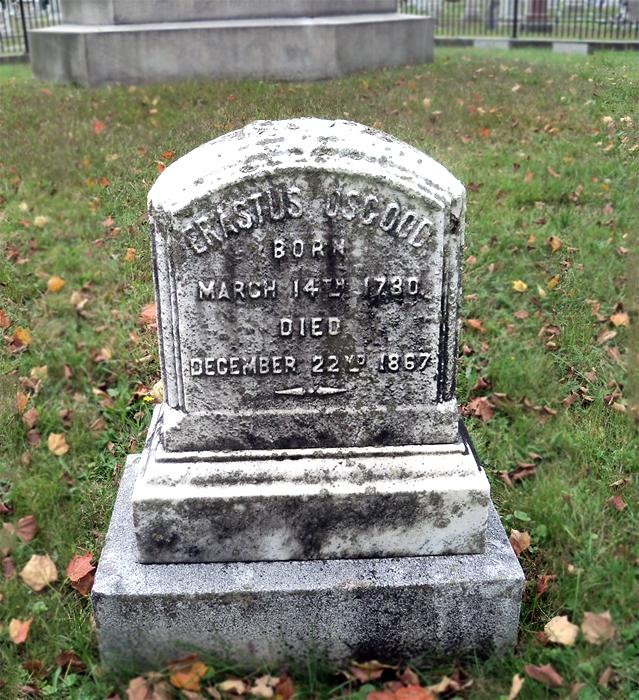
References

1819-1870 Samuel C. Osgood

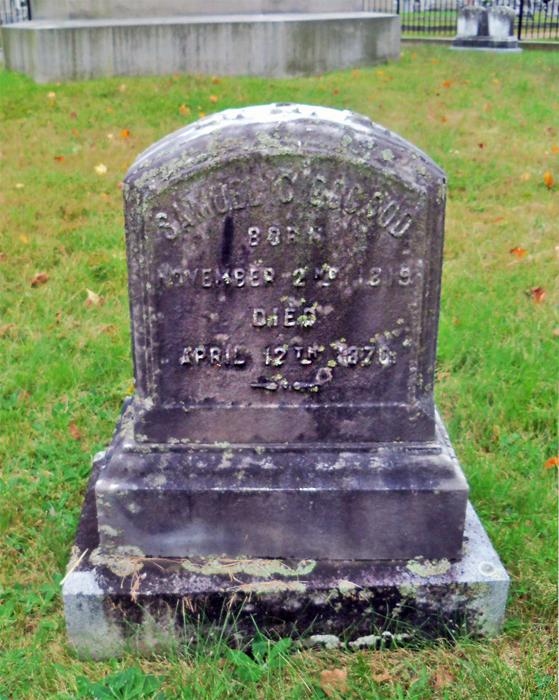
 Samuel C. Osgood was born on November 2, 1819, and died at the age of 50 on April 12, 1879. He was the son of Dr. Erastus Osgood and Martha Morgan Osgood.


Need more info

References

1823-1871 Gilbert Osgood

Gilbert Osgood was a member of the prominent Osgood family. His father, Dr. Erastus Osgood, was a successful physician who practiced for nearly half a century, and his older brother, Charles, was a local druggist, a patent medicine inventor, and a former mayor of Norwich.

Gilbert Osgood came to Norwich in 1842 to work as a clerk for his brother, Dr. Charles Osgood. He later became a partner in the firm, Charles Osgood and Company.  Gilbert ran the firm’s New York City operation. The company later changed its name to Lee and Osgood Pharmacy.

Gilbert died of pleurisy on February 2, 1871, at the young age of 47.  Pleurisy (or pleuritis) is an inflammation of the pleura, which are the two thin layers of tissue surrounding the lungs and lining the inside of the chest cavity.

The February 23, 1871 edition of the Norwich Bulletin printed his obituary and the following advertisement for one of the products his firm sold.

“Osgood’s Cough Remedy, For coughs, colds and all diseases of the throat and lungs … 146-148 Main St.”

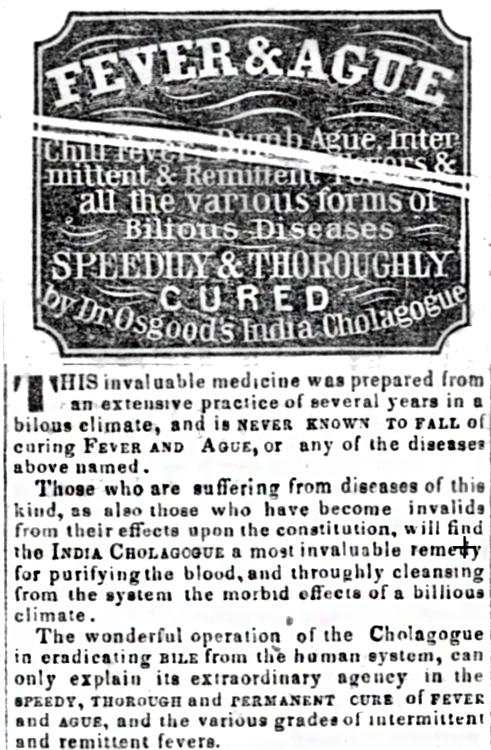
The Lee and Osgood sold a variety of drugs, including “Osgood’s Cough Remedy” and “Osgood’s India Chologue”. Gilbert’s brother, Charles, developed both patent-medicine remedies.

The image shown here is an advertisement for “Osgood’s India Chologue”.

Gilbert married Mary Sangar Backus. They had four daughters:

1) Lillie Morgan (1856-1935)

2) Mary Gilbert (1858-1947)

3) Carrie Backus (1860-1862)

4) Martha Louise (1864-1956) 

*Place your cursor over the photos to magnify

References

1849-1923 Frederic Larned Osgood

Frederic Larned Osgood, one of Dr. Charles Osgood’s sons, was one of Norwich’s most popular mayors, broad-minded and liberal in his views, and wise in his administration. He was genial in disposition and easy to approach. He listened with patience to all sides of the questions he was called upon to settle.

He served as Norwich’s Chief of Police from June 16, 1884, to June 14, 1885. The position was unpaid and appointed by the Norwich City Council at the time. Eleven years later, he served as Norwich’s Mayor from 1896 to 1900.

Fred Osgood was also a popular socialite and an enthusiastic yachtsman. His yacht, Fedalma, is shown in the photo. He also owned the yachts Tillie and Narwhal. He was a member of the New York Club, the New York Yacht Club, the Larchmont Yacht Club, the Atlantic Yacht Club, and the Norwich Club.

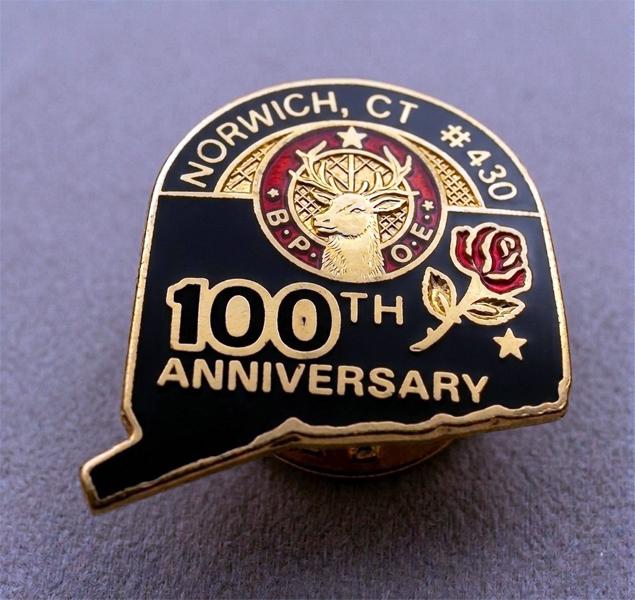
He also served as the First Exalted Ruler of the Norwich BPOE Elks Lodge #430. Established in 1898, the Elks met in the Norwich building now occupied by Hotel Callista.

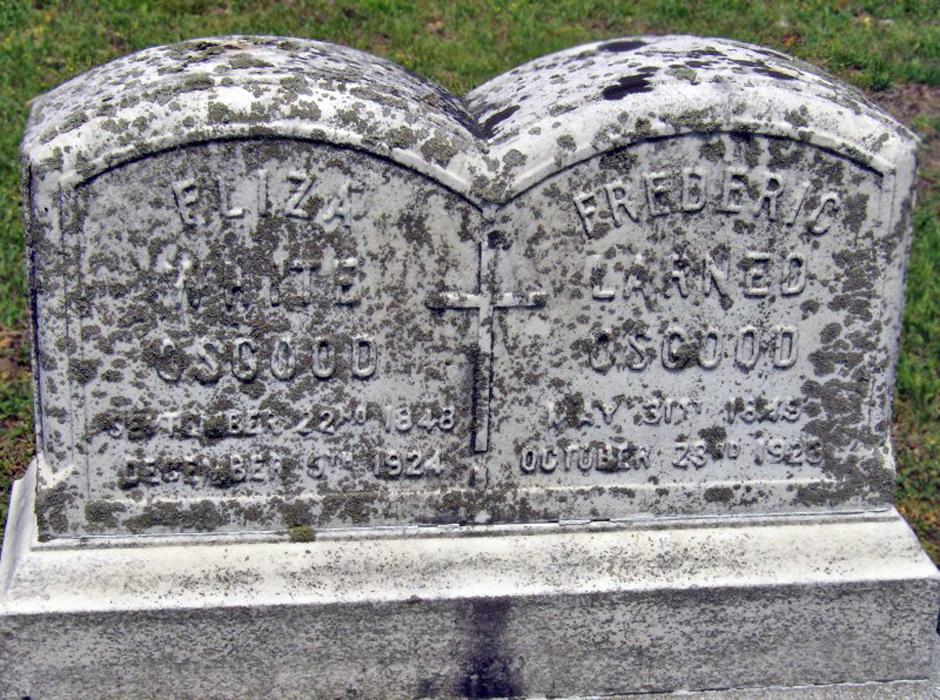
He and his wife, Eliza White Osgood, are buried in Yantic Cemetery.

References

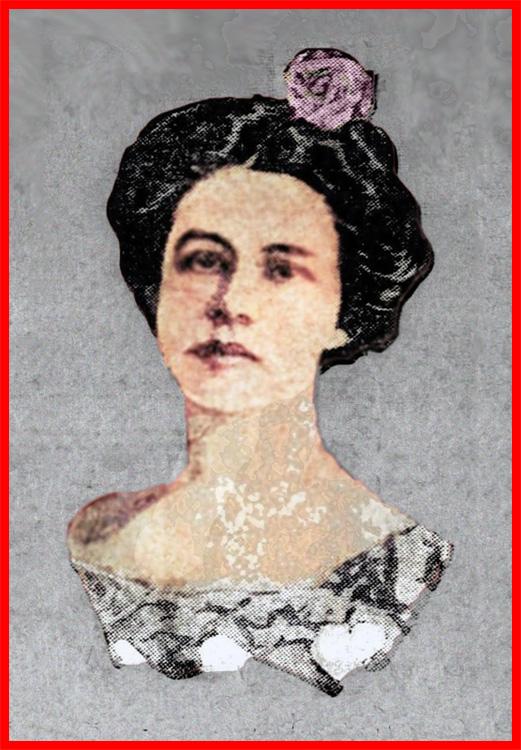
1850-1920 Gertrude Haile Lanman

Gertrude Haile Lanman

Gertrude Haile was born on September 29, 1850, in  Norwich.  Her parents were  Dr. Ashbel Bradford Haile and Mary Hall May of Savannah, GA, a family of distinction and wealth. Gertrude married William Camp Lanman, nephew of Commodore Joseph P. Lanman, on June 18, 1873, in Norwich, CT.

Her husband, William, was a partner in Lanman & Sevin, druggists in Norwich, CT. Due to poor health, he retired early in life, and the couple traveled internationally, spending considerable time in Southern France and rural England. While in Europe, Gertrude took a special interest in art and was particularly fascinated by the cathedrals. Following her husband’s death in 1903, she joined the Christ Episcopal Church.

Gertrude Haile Lanman grew to become one of the most brilliant leaders of society in Norwich and one of the wealthiest women in the state of Connecticut; fortunes which she inherited with the passing of her father, Dr. Ashbel B. Haile (1880), and an Aunt, Miss Gertrude May of Savannah, her namesake. She was also well known in New York’s highest society and accustomed to spending extended stays at exclusive hotels in Manhattan. The Lanman residence, located at 218 Washington Street, was the focal point for many lavish events hosted by Gertrude. Called “The Ghlanbouer”, her residence was considered one of the showplaces of Norwich, in which Gertrude entertained with exceptional elegance and grace.

Using her wealth and political clout, Gertrude established the Haile Club (1907), a safe place for the welfare of young employed women, located in a three-story building on Main Street in Norwich. The Haile Club became home for many women. It was a place where they could find housing, food, and receive medical care and counseling. There was a large auditorium where meetings were held. Gertrude Lanman managed the club’s daily operations and reported a membership of over 500 women. In the late 1800s, Suffragette meetings were routinely held at the Haile Club. During the summer months, Gertrude instituted a program in which small groups of young women from New York City would come to Norwich to get away for a week and enjoy fresh, healthy country air before returning to the city.

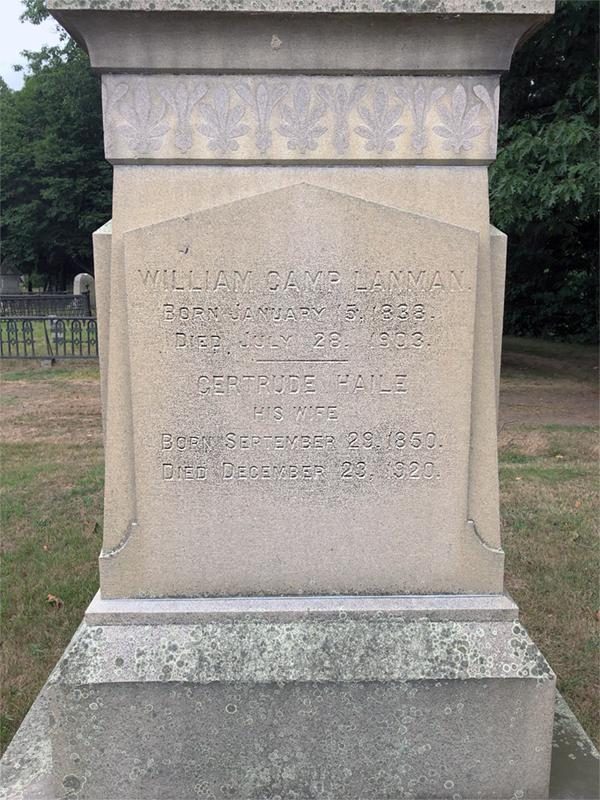
Gertrude_Lanman_gravesite
Gertrude Haile Lanman Gravesite

As the years passed, Gertrude concentrated on living a more simplified spiritual life. In 1909 she became interested in and joined the Roman Catholic Church. In 1911 she traveled to New York City to be received into the Convent of the Sisters of the Reparation on East 29th Street.  

In keeping with the Scriptural instruction, it is easier for a camel to pass through the eye of a needle than a rich man to enter the kingdom of heaven; Mrs. Lanman began the process of disposing of her jewels, art objects, and her beautiful residence in Norwich, one of the most beautiful in all Connecticut. She donated $1,000,000 to the Catholic Church. Money from her collection of jewels went to the Haile Club.

During the latter part of her life, Mrs. Lanman is quoted as saying: 

“I have tried all the pleasurers that the world has to offer. All are unsatisfying. My happiness henceforth will lie in following in our Lord’s footsteps and in laboring for others.”

References

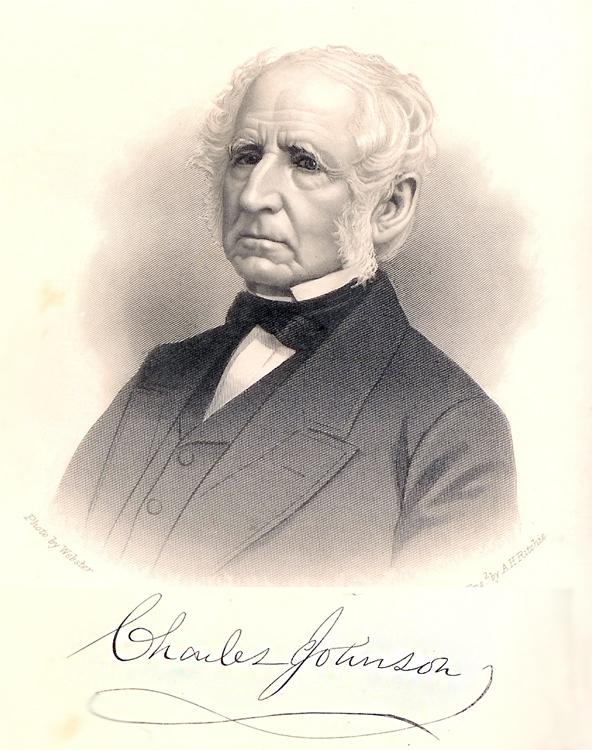
1806-1879 Charles C. Johnson

Charles Johnson was born in Jewett City, April 1806, the fourth son of nine children of Obadiah and Lucy (Cady) Johnson.  When about fourteen years of age, Charles began working in the local cotton mill. After two years, he was taken into the factory-store and office, where he remained until the mill was sold to Samuel and John Slater in 1823. In 1824, Charles was employed as an accountant by the Hopkins & Morse Machine Company of Norwich, then in 1827 as a bookkeeper in the Griswold Woolen Co., by Trumbull, Breed & Co. 

At twenty-one, Charles invested his savings in partnership with his father in a prosperous mercantile enterprise under the firm name of John Johnson & Son. This early success was a clear indication of his shrewd business acumen. Later, he managed a store at Norwich Falls under the firm name of Cobb & Johnson.

When the Jewett City Bank was established in 1831, Mr. Johnson was appointed as its cashier at a modest annual salary of $200 ($7,700 in 2026 $).

Three years later (1835), Mr. Johnson accepted a cashier’s position at the Norwich Savings Bank at a yearly salary of one thousand dollars. He was appointed a trustee in 1840 and then became a director. In 1847, upon the death of the late Jabez Huntington, Charles Johnson was chosen president of the Norwich Savings Society, a position he held until his death in April 1879. The Norwich Savings Society was the second-oldest and largest savings bank in the state. Under Charles Johnson’s leadership, the deposits swelled from less than $150,000 to nearly $8,000,000. The bank’s clientele grew to about 50,000 customers.

In addition to his regular banking business, Mr. Johnson was called upon to administer several public and private trusts. He was a trustee for the Otis Library from the first meeting of the trustees and for the fund supporting the families of Civil War veterans.

Mr. Johnson was a director of the Norwich & Worcester Railroad from 1848 to 1869. From 1845 to 1851, he was president of the Norwich Fire Insurance Company. For six years before his death, he was involved in reorganizing the Southern Minnesota Railroad. He was the originator of the Norwich City Gas Company and served as a director until his death. In 1864, his income was reported to be $8,417 ($194K today).

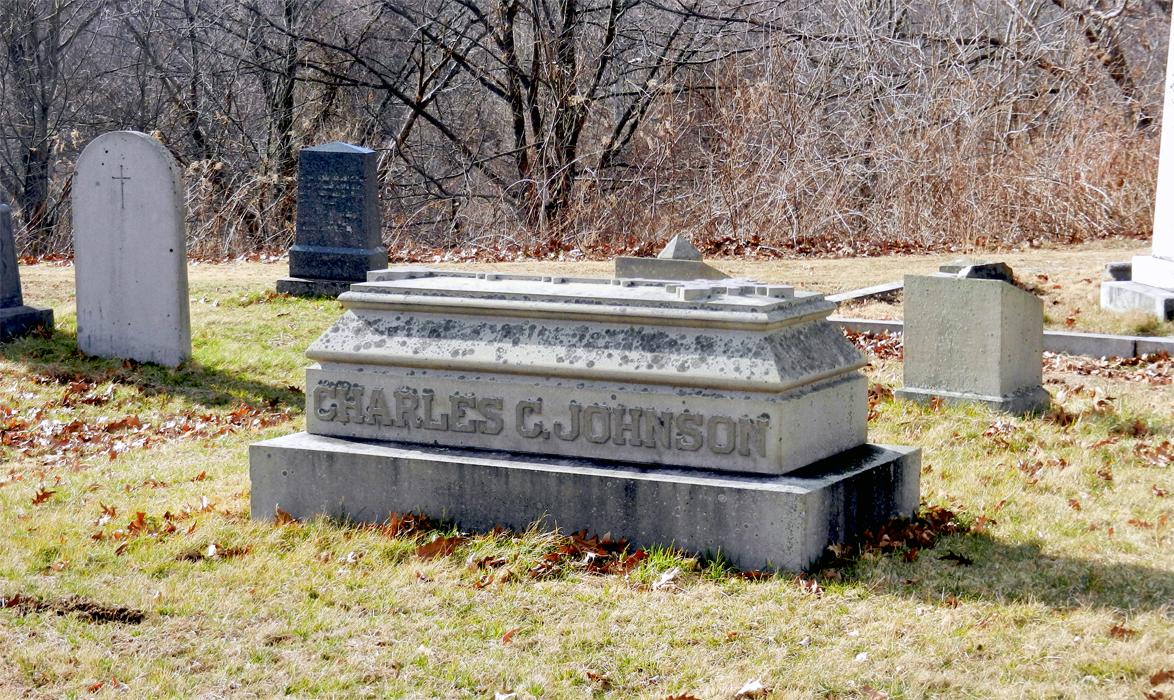
Charles C. Johnson Gravesite

Mr. Johnson was an active member of the Second Congregational Church until the formation of Park Congregational Church. Charles Johnson was one of the incorporators of the Norwich Free Academy. Although he lived a very unostentatious life and died without any significant accumulation of wealth, it has been estimated that Charles Johnson distributed nearly $150,000 during his life for religious and benevolent purposes, as well as personal charities. Never one to be swayed by a politician and not always hopeful in his views, he nevertheless took a decided interest in national affairs and was fond of discussing them with his friends. During the anti-slavery movement, he was a strong abolitionist and a proponent of universal human brotherhood.

During his lifetime, Mr. Johnson’s life was robbed three times by the untimely deaths of his conjugal partners and the loss of two children. The only surviving child was Mr. Charles C. Johnson, Jr. of this city.

References

1793-1855 Charles Coit

Colonel Charles Coit was born in February 1793 and, at a young age, took part in the War of 1812. Afterward, Charles was active in the militia, rising to the rank of colonel in the artillery. He came to Norwich in 1817 and engaged in the mercantile business, which he pursued in various forms, particularly the grocery business, which he actively pursued until his death in October 1855 at the age of sixty-two.

Charles was a member of the Second Congregational Church, serving as Deacon and superintendent of the Sabbath School.

Charles married Lucretia Tyler in May 1821, who died in 1822. He soon married again, Lydia Tyler, the sister of his first wife, who died in October 1834. From this second marriage, two children were born, Lucretia and one unnamed, both of whom died in infancy.

A third marriage took place when Charles married Sarah Perkins Grosvenor, the daughter of General Lemuel Asa Grosvenor. They had four children: Ellen Grosvenor (1835), Charles Morgan (1838 – 1878), Sarah Perkins (1840 – 1843), and George Douglas (1845-1906). Following her husband’s death, Ellen Grosvenor Coit left Norwich to spend her winters in New York and her summers at Eastern Point in Groton.

References

1838-1878 Charles Morgan Coit

Charles Morgan Coit, son of Charles Coit, was born in Norwich in March 1838. At the age of seventeen, the death of his father caused him to drop out of college and enter the business world reluctantly. He was initially employed at the Uncas Bank in Norwich. Still, at the young age of twenty-one, he was soon selected to be treasurer of the Chelsea Savings Bank, following the departure of the previous treasurer after just one year of service. Charles was held in the highest esteem by bank officials, so that when the Civil War broke out, if he volunteered to fight, his bank position would remain open for him. Unable to leave home due to family and business obligations when the first call for enlistment was made, Charles could not resist Lincoln’s second call for volunteers and, in 1861, joined the service as adjutant of the 8th Connecticut Volunteer Infantry, organized under General Edward Harland. 

Charles was wounded at Fair Oaks, Virginia, in 1864, and upon his recovery, he was promoted to brevet in March 1865 and discharged in May 1865.  Upon returning to Norwich, Colonel Coit was offered his former position as treasurer of the Chelsea Savings Bank, which he accepted.

Charles was an aide to Second Congregational Church as Deacon and treasurer.

Colonel Coit lost his life in July 1872 by drowning in New London. His infant son had fallen overboard from a yacht, and in his effort to rescue his little boy, which he was successful in doing, he lost his own life.

Charles was married to Mary B. Hillard in June 1872. They had two sons: Charles (1873) and Augustus (1876).

Following the untimely death of Colonel Charles Coit in 1872, his brother George D. Coit, then treasurer of the Dime Bank, was chosen to fill his position of treasurer at the Chelsea Savings Bank. In July 1878, George transferred his services to the Chelsea Savings Bank, where he remained until his death in October 1906.

Reference